
Maverick Transportation Trucking School Review – Company Paid CDL Training

If you’re tired of trading hours for a paycheck that never quite stretches far enough, a Class A CDL is one of the few remaining doors into a skilled, in-demand trade you can walk through in a matter of weeks, not years. You don’t need a four-year degree, you don’t need to go into debt, and you don’t need prior experience to get started. What you need is a company willing to pay you while you learn the job, hand you the keys to a truck you’re actually proud to drive, and give you room to grow your income year after year. Maverick Transportation built its student program around exactly that idea.
The Maverick Way began in a one-room office in Texarkana, Arkansas in 1980. Maverick’s growth over the last 46 years has been built on the principles that founder and CEO Steve Williams calls “The Maverick Way”, which is “doing what you say you will do with integrity, respect, and commitment”.
Maverick Transportation, based out of Little Rock, AR – has become an industry leader, building their reputation on safety, technology, innovation, and a progressive mentality of doing things the Maverick Way. Today, almost 2,000 employees back every load they haul. Maverick operates 1,600+ trucks coast-to-coast, in Canada and to Mexico providing customized logistics solutions to some of the nation’s finest corporations. The company now runs out of eight U.S. locations and has logged more than 250 million awarded safe miles, and roughly 40% of its drivers have been with Maverick for four years or more.
Maverick’s student driving opportunities provide the training you need to become a top-earning professional driver. Their innovative student program offers paid hands-on training in flatbed and glass divisions. You’ll work with the best instructors and the safest equipment in the industry to get your new career in gear!
Why Maverick’s Program Costs You So Little to Start
The biggest thing standing between most people and a trucking career isn’t ability. It’s money. Paying out of pocket for CDL school, then living with no income for a month or two while you train, keeps a lot of good candidates stuck where they are. Maverick’s student program is designed to remove that wall.
From the day you arrive, you’re on the clock and getting paid. Your travel to North Little Rock, your lodging, and your breakfast and lunch during training are all covered by the company. You spend your first weeks earning a check and learning the job instead of draining your savings to chase a license.
If you already earned your CDL somewhere else, Maverick’s Tuition Reimbursement Program can help you recover part of what you spent, so you’re not penalized for having taken initiative. And because Maverick is approved for on-the-job training under the GI Bill®, veterans can put their earned benefits to work while they train and draw a paycheck at the same time.
Compare that to the traditional route, where a private CDL school can cost several thousand dollars up front and offers no income while you study. Maverick flips the math: the paychecks start early, the major training expenses are handled, and you walk out with a job instead of a loan balance. For someone supporting a family or rebuilding after a rough stretch, that difference is the whole ballgame. It’s the reason so many people who assumed a new trade was out of reach end up behind the wheel within a couple of months.
How the Training Actually Works, Step by Step
Maverick’s process is built to move you from applicant to solo, self-supporting driver without any guesswork about what comes next. Here’s how the road unfolds.
Getting Pre-Qualified and Applying
If you prefer, call a Maverick recruiter first. They will ask a few questions and “pre-qualify” you to make sure that you’re a good fit for the company. After you’ve been pre-qualified by a recruiter, you can submit your application. Maverick will process your application up front, completing all background reports and previous employment verifications. Processing typically takes 3 to 5 business days.
Paid Pre-Employment Evaluation (PRE)
Once your application is approved, Maverick invites you to a paid Pre-Employment Evaluation, or PRE, at its headquarters in North Little Rock, Arkansas. This is the step that used to be called orientation, and it’s where the company confirms you’re ready for the road while you get to know how Maverick operates.
During PRE you’ll complete your DOT physical, which includes a DOT urinalysis and a non-DOT hair follicle test, along with the paperwork that gets you set up as a Maverick driver. Maverick pays for all applicable testing during this stage. Travel, lodging, breakfast, and lunch are provided, and if you’d rather drive yourself in, the company will reimburse your mileage.
What to Bring With You
Don’t forget to bring:
- Valid driver’s license
- Social Security card
- Birth certificate
- Passport or Passcard (or receipt of application) – if you’ll be going into Maverick’s glass division
- Emergency contact information
- Rand McNally Motor Carrier Atlas
- 25ft tape measure
- Pen/pencil and paper
- Calculator
- Alarm clock
- Social security numbers and birth dates of everyone you want covered by your insurance
Business Unit Training and One-on-One Road Mentoring
Drivers with less than six months of over-the-road experience go through roughly six weeks of training. After four days of paid PRE, you’ll spend about seven days in paid Business Unit Training in North Little Rock, where you learn the specific skills of the division you’re joining, whether that’s flatbed or glass.
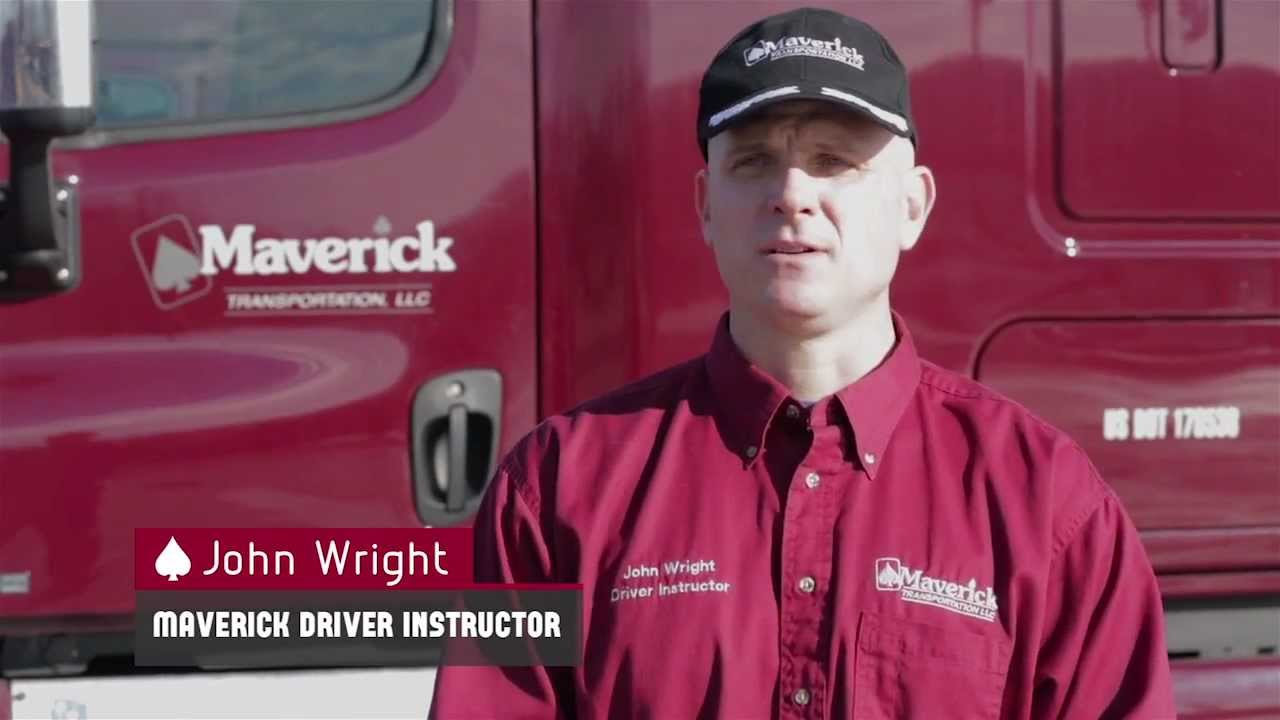
From there you’re paired one-on-one with an experienced Maverick driver trainer for your trainer-truck time. This mentor rides with you through real freight, real routes, and real deadlines, coaching you until you’re ready to test out and take a truck of your own. Maverick’s trainers bring well over a hundred years of combined industry experience to the seat next to you.
The Balance of Classroom, Range, and Road Training
Let’s face it, good training moves in a logical order. You start with the rules and the “why,” you practice the physical skills in a controlled space, and then you put it all together on real highways with a coach beside you. Maverick’s program follows that same arc. Maverick’s paid CDL training isn’t one long lecture or one endless ride-along. It’s built in three phases that build on each other, so you’re never thrown into something you haven’t been prepared for. You learn the rules and theory in the classroom, turn that knowledge into physical skill on a closed driving range, and then prove it on real highways with an experienced trainer in the passenger seat.
The mix is deliberate. Classroom days front-load the reasoning behind the job, range days drill the hands-on maneuvers until they’re automatic, and road miles tie it all together under real conditions. Because Maverick pays you through every phase, you move from theory to yard work to live freight while earning a check, and no single stage drags on longer than it needs to before you’re driving for real.
Classroom Instruction at Maverick’s Paid CDL Training
During your time at CDL School, you’ll be in class/training Monday thru Friday. Here’s some of the skills you’ll learn:
- Basic commercial driving skills
- Arkansas commercial driving laws
- Federal commercial driving regulations
- Drivers logs
- Industry-specific safety practices
Classroom work is where the language of the job stops sounding intimidating. Everything gets explained in plain terms before you’re asked to put it into practice, so you walk onto the range already understanding what you’re doing and why it matters. The material breaks down into three main areas.
Federal and State Driving Regulations
You’ll learn the federal rules every commercial driver operates under, from Federal Motor Carrier Safety Administration standards to the Arkansas commercial driving laws you train beside. This covers weight limits, load restrictions, and the roadside inspection process, so you understand exactly what an officer checks for and how to keep your truck legal at every scale house.
Logbooks, Hours of Service, and ELDs
A large share of classroom time focuses on Hours of Service, the federal rules that dictate how long you can drive and when you have to rest. You’ll learn to run an electronic logging device, record your duty status accurately, and plan your day so you stay compliant without leaving miles on the table. Getting comfortable with logs early takes one of the most common new-driver worries off the table.
Safety Practices and Securement Theory
Because Maverick runs open-deck freight, the classroom also covers the theory behind load securement long before you touch a chain or a strap. You’ll study weight distribution, working load limits, tarping principles, and the safety habits that protect both you and the motoring public. This groundwork is what makes the hands-on range training click.
Driving Range Training at Maverick
The range is where theory becomes muscle memory. In a controlled yard, away from traffic, you’ll practice the maneuvers that make or break a new driver: straight-line backing, offset backing, and the parallel and dock parking you’ll do every working day. You’ll also learn the pre-trip inspection cold, walking a tractor and trailer and calling out every component until it becomes second nature.
Pre-Trip Inspections
You’ll learn to inspect a tractor and trailer the way a professional does, walking the equipment and calling out every component from brakes and tires to lights and coupling devices. The pre-trip becomes second nature through repetition, and it’s both a daily safety habit and a graded part of your CDL exam.
Backing, Turning, and Maneuvering
Backing a 70-foot vehicle is the skill that intimidates most newcomers, so the range gives it plenty of attention. You’ll practice straight-line backing, offset backing, and the parallel and dock parking you’ll do at customers every day, along with tight turns and the spatial awareness that keeps you clear of obstacles. Reps in a controlled yard build the confidence you’ll carry onto real docks.
Load Securement and Tarping
This is where Maverick’s training separates itself from a standard dry-van school. You’ll get hands-on practice with chains, straps, and tarps, learning to secure and cover open-deck freight so it arrives exactly the way it left. These are the premium skills that make flatbed and glass drivers more valuable, and you’ll drill them until they’re routine.
Because Maverick runs open-deck freight, range work also covers what most dry-van schools never touch. You’ll get hands-on reps with load securement, chaining, strapping, and tarping, learning how to lock down freight so it arrives exactly the way it left. These are the skills that set flatbed and glass drivers apart, and they’re a big part of why those drivers earn more.
Behind-the-Wheel on the Road Training at Maverick Transportation
The final stretch of training happens on live routes with your driver trainer. This is where you build real confidence: shifting through grades, handling mountain descents, backing into tight customer docks, and planning a trip so your drive time, fuel, and delivery windows all line up.
Real Freight and Trip Planning
You’ll haul actual customer freight under real deadlines, learning to plan a trip so your drive time, fuel stops, and delivery windows all line up. Your trainer walks you through communicating with your fleet manager, reading your route, and managing your clock, so the logistics of the job feel familiar before you ever go solo.
Mountain, City, and Interstate Driving
Real routes throw real conditions at you: steep grades, long mountain descents, crowded interstates, and tight city streets. With a trainer beside you, you’ll learn to shift through the hills, control your speed on downgrades, and handle heavy traffic calmly, skills you simply can’t build on a closed range.
Life on the Road With Your Trainer
Behind-the-wheel training is also your first real taste of the OTR lifestyle. You’ll settle into a rhythm of driving, resting, eating, and living out of the truck, coached by someone who has done it for years. By the time you test out of the trainer truck, you’ve already lived the day-to-day of the career you’re stepping into.
The Equipment You’ll Train On
At Maverick Transportation’s paid CDL training program, you won’t learn on worn-out, hand-me-down rigs. Maverick trains you in the same class of late-model tractor-trailers you’ll drive as a solo company driver, and the fleet runs automatic transmissions as standard. That lets you spend your energy learning to drive and secure freight instead of fighting a clutch and a manual gearbox, which shortens the learning curve for career-changers who have never handled anything this size.
The training equipment is kept in the same top condition as the rest of the fleet, with the same safety technology you’ll rely on once you’re solo, including collision mitigation with active braking and camera-based mirrors. You get comfortable with the real tools of the job from day one rather than learning on something you’ll never actually drive.
The Flatbed Division Student Program
Flatbed is the backbone of Maverick’s business, and it’s where a large share of new students start their careers. If you like being physically involved with your freight and want to build a skill set that pays a premium, this is a strong fit.
What Flatbed Hauling Looks Like at Maverick
Maverick made its name in the open-deck and flatbed world, and it’s regarded as one of the best in that space. Flatbed drivers haul freight that won’t fit in a box: steel, building materials, machinery, and other oversized or irregular loads carried on an open trailer.
The job asks more of you than dry van work. You’ll secure and tarp your own loads, which means you’re out of the seat, working with your hands, and staying active through the day. Maverick’s extended training program exists for drivers who arrive with no flatbed background, so you’re never expected to already know how to do it. The company teaches you the proper securement techniques from the ground up.
Flatbed Student Pay and Home Time
Maverick rolled out a flatbed pay increase for 2026, and the student numbers reflect it. As a flatbed student driver, you can expect to earn $73,000 to $80,000 in your first year, with a weekly average landing in the $1,400 to $1,600 range once you’re rolling on your own.
Here’s how the flatbed student pay package breaks down:
- Starting pay of $.59 per mile on Regional and OTR flatbed lanes
- $1,000 paid PRE (Pre-Employment Evaluation) with travel, lodging, breakfast, and lunch provided
- $1,000 Flatbed Business Unit Training pay
- $15 per hour Detention Pay and $50 Tarp Pay
- A weekly guarantee once you go solo
- Pay-for-Performance bonus program worth up to an extra $.06 per mile
- Scheduled pay increases through your first five years
- $1,000–$2,000 CDL-A driver referral bonus (rehires are not eligible)
Home time is one of the flatbed division’s strongest selling points. Most flatbed drivers get home weekly or most weekends, and regional, OTR, and dedicated options let you match your route to the kind of home life you want. Weekly averages run around 2,000 to 2,300 miles.
The Glass Division Student Program
Maverick’s glass division is a specialty within a specialty, and it pays accordingly. If you want a challenge that keeps the job interesting and a paycheck to match, glass is worth a serious look.
What Glass Hauling Looks Like at Maverick
Maverick is one of the largest and most reputable glass carriers in North America. It takes a specific kind of driver to haul the largest glass moving on America’s highways, and the company builds an exceptional pay package around that skill.
A major perk of the glass division is how the freight is handled. Around 89% of glass loads are pre-loaded, so you spend less time loading and more time driving and earning. Glass drivers run all 48 states and Canada, which means the routes stay varied and the miles keep coming. Because several glass lanes cross into Canada, you’ll want the proper documentation, which is why a passport belongs on your packing list for this division.
No glass experience? Don’t worry. That’s expected. Maverick provides focused, detailed securement training with some of the best instructors in the industry, and its extended training program is available to anyone who needs extra time to get comfortable.
Glass Student Pay and Home Time
As a glass student driver, you can expect to earn $76,000 to $85,000 in your first year, one of the highest starting ranges available to a brand-new driver in the industry.
The glass student pay package includes:
- Starting pay of $.62 per mile
- 89% pre-loaded freight
- $750 paid PRE (Pre-Employment Evaluation) with travel, lodging, breakfast, and lunch provided
- $700 Glass Business Unit Training pay
- $100 Live Load Pay and $100 Canada Border Crossing Pay
- $50 Tarp Pay and $30 Glass Rack Pay
- $15 per hour Detention Pay
- Pay-for-Performance bonus program worth up to $70 per week
- Scheduled pay increases through your first five years
- $1,000–$2,000 driver referral bonus (rehires are not eligible)
Glass drivers get home every other weekend or every 12 to 14 days, running around 2,000 to 2,300 miles a week. You earn paid time off you can use in half-day or full-day increments, and the division treats family time as a genuine priority even with its longer runs.
First-Year Earnings and What Happens After Five Years
One of the fairest questions any career-changer can ask is simple: what will I actually make now, and what can I make later if I stick with it? Maverick’s numbers give an honest answer on both counts.
Your First Year on the Road
A first-year student driver at Maverick earns between $73,000 and $85,000 depending on division, with a typical weekly average of $1,400 to $1,600. Flatbed students start around $.59 per mile and glass students start around $.62 per mile, and both divisions add a weekly guarantee after you go solo so a slow week doesn’t gut your paycheck.
On top of base mileage pay, the Pay-for-Performance bonus program rewards safe, efficient driving with up to an extra $.06 per mile. Accessorial pay for tarping, detention, live loads, and border crossings stacks on top of that, so the drivers who lean into the work tend to land at the higher end of the range.
Broken down by division, flatbed students generally earn about $73,000 to $80,000 in year one, which works out to a weekly average in the neighborhood of $1,400 to $1,540. Glass students tend to run a little higher, roughly $76,000 to $85,000 a year, or about $1,460 to $1,635 a week, thanks to the specialty pay that comes with hauling glass.
Those weekly numbers aren’t a ceiling. Detention pay at $15 an hour, tarp pay, glass rack pay, live-load pay, and Canada border-crossing pay all get added on top, and the Pay-for-Performance program can lift your per-mile rate by as much as $.06. A driver who runs consistent miles and works the accessorial pay can reach the top of the range well before the first year is out.
Pay Growth Through Year Five and Beyond
Maverick builds in scheduled pay increases across your first five years, so your rate climbs as your experience does. You’re not stuck at your starting number waiting on a raise that never comes; the raises are part of the program.
By the time you’ve put in several years and moved into Maverick’s experienced ranks, the ceiling rises considerably. Experienced flatbed drivers earn $84,000 to $96,000 a year, with starting rates in that group running $.63 to $.675 per mile. Experienced glass drivers earn $85,000 to $100,000 and up, starting around $.69 to $.745 per mile, and Maverick’s top glass drivers clear $105,000 a year. Drivers who move into dedicated, final-mile, or marine lanes can reach similar territory, and experienced drivers coming in with six months or more behind them can qualify for a $3,000 sign-on bonus.
Here’s what that looks like week to week. An experienced flatbed driver earning $84,000 to $96,000 a year takes home somewhere between $1,615 and $1,845 in an average week. Meanwhile, an experienced glass driver in the $85,000 to $100,000+ yearly salary range earns roughly $1,635 to $1,925 a week. The top glass earners past $105,000 per year clear close to $2,000 in a strong week once accessorial and performance pay are counted.
Five years in, most Maverick truck drivers have also settled into whatever schedule fits their life, whether that’s a high-mileage OTR lane, a regional run that gets them home on weekends, or a dedicated account with a set routine. Longevity is common here: roughly 40% of Maverick drivers have been with the company four years or more, which tells you the pay and the lifestyle hold up over time. It also says a lot about how well Maverick Transportation treats its drivers. Stack annual raises, performance pay, and the referral bonuses drivers can earn throughout the year, and a veteran Maverick driver’s total earnings sit comfortably above where they began.
The Path From Graduate to Company Driver
Maverick’s student program isn’t training that leaves you to fend for yourself afterward. The whole structure exists to feed Maverick’s own fleet, which means finishing the program and meeting the company’s hiring requirements puts a driving job directly in front of you.
Once you test out of the trainer truck, you’re assigned your own truck and set loose on real freight with a weekly guarantee backing your paycheck. From that point, advancement is built into the culture. Milestone recognition kicks in at your six-month mark and again through your first year, and standout performers can earn Maverick Ace status by hitting rigorous targets four quarters in a row.
Drivers who prove themselves through all four seasons, keep a clean safety record, and take pride in their equipment can eventually become Road Trainers themselves, mentoring the next wave of students and opening another lane of income and respect. The company also runs Driver of the Month and Driver of the Year honors, giving its best drivers a real voice with leadership through the Driver Advisory Council.
The OTR Lifestyle: An Honest Look at the Trade-Offs
Over-the-road driving changes your life, and it’s only fair to talk about both sides of that. The rewards are real, and so are the adjustments.
On the reward side, the income is dependable, you’re your own boss for most of the day, and you get paid to see parts of the country most people only drive through on vacation. There’s a quiet pride in hauling freight that keeps factories running and job sites moving, and a lot of drivers describe the work as giving them a sense of purpose they never got from an office or a warehouse.
The honest challenge is time away from home. OTR runs can keep you out for two to three weeks at a stretch, home two to three days, and the road rewards discipline with your sleep, your meals, and your money. It isn’t for everyone, and Maverick doesn’t pretend otherwise.
What makes the difference is choice. Maverick runs OTR, regional, dedicated, local, and final-mile lanes, so the amount of home time you get can flex with your life. Regional drivers are home most weekends, dedicated routes can put you home daily, nightly, or weekly, and final-mile positions can have you sleeping in your own bed every night. You’re guaranteed to be home for Thanksgiving and Christmas, and the passenger program lets a rider aged 13 or older come along at no cost so you don’t have to travel alone.
The Equipment, Safety Technology, and Life in the Truck
The truck you drive is your workplace and, on longer runs, your home. Maverick puts serious money into making both comfortable and safe.
The tractors and trailers you’ll operate are late-model and kept in top condition. Maverick cycles its equipment on a regular replacement schedule, so as a company driver you’re assigned a current, well-maintained truck rather than a worn-out rig, and every tractor runs an automatic transmission with air-ride suspension for a smoother, easier drive. Trailers are matched to your division, whether that’s flatbeds and step decks for open-deck freight or the specialized trailers the glass and marine divisions run.
Every truck comes loaded with driver-assist safety technology: a collision safety system with active braking, roll stability control, tire pressure monitoring, and Stoneridge MirrorEye camera mirrors that widen your view and cut blind spots. Automatic transmissions are standard, which flattens the learning curve for new drivers and takes strain off long days.
Trucks are governed at 65 mph, and Maverick’s PasSmart technology lets you push up to 70 mph for one hour within an eight-hour driving period when you need to make a pass or a delivery window (divisions running into Canada don’t carry the PasSmart option). Paid weigh station bypass and tolls keep you moving instead of waiting in line.
Inside the cab, you get in-truck WiFi, a refrigerator, an APU or EPU to keep the truck comfortable without idling, and a spot to mount a flat-screen television. You’re assigned your own truck rather than sharing, and you can take it home during your home time as long as it’s parked somewhere safe.
Your Freightliner Day Cab or Sleeper Tractor
Maverick runs a modern fleet of Freightliner tractors, and the one you’re assigned depends on your lane. Day Cabs go to regional, dedicated, local, and final-mile drivers who get home often and don’t need a berth, while roomy Sleeper tractors give over-the-road drivers a comfortable place to rest on multi-week runs. Every tractor is an automatic with air-ride suspension, which smooths out the ride and shortens the learning curve for drivers who are new to equipment this size.
Both cab types carry Maverick’s full driver-assist safety suite: collision mitigation with active braking, roll stability control, tire pressure monitoring, and Stoneridge MirrorEye camera mirrors that widen your view and cut blind spots. The Sleeper models are outfitted to live in, with in-truck WiFi, a refrigerator, an idle-free APU or EPU for overnight heating and cooling, and a flat-screen television mount. Because the truck is assigned to you alone, it starts to feel less like a work vehicle and more like a second home on the road.
The Trailers and Flatbeds You’ll Pull
What you pull behind that tractor depends on your division and your freight, and Maverick’s trailer pool is one of the most varied in open-deck trucking. Flatbed drivers run standard 48-foot and 53-foot flatbeds along with step decks and double drops for taller or heavier loads. Depending on the freight, you might also pull a 48-foot side kit trailer, a Conestoga, a curtainside, a drop-center chip trailer, or an open-top van, and several of these come rigged with A-frames for carrying glass or with a roller-tarp system that makes covering a load faster and easier.
The glass division runs A-frame flatbeds and step decks purpose-built to move large glass safely, while the marine division pulls dedicated boat and pontoon trailers, including 53-foot boat trailers and marine step decks, to haul the boats that make Maverick the largest boat hauler in North America. Some routes pair a shorter flatbed or a straight truck with a truck-mounted Moffett forklift, so you can offload building products yourself right at the job site. Whatever your division, the trailer you’re assigned is matched to the work and kept to the same standard as the tractor pulling it.
The Maverick Life After You Go Solo: Choosing Your Lane
One of the underrated advantages of starting at a carrier the size of Maverick is that your first driving job doesn’t have to be your only kind of driving job. As your life changes, the company has lanes that can change with you, and moving between them doesn’t mean starting over somewhere new.
Flatbed OTR Driver
Flatbed is Maverick’s flagship division. You’ll haul steel, building materials, machinery, and other freight that rides on an open trailer, which means you secure and tarp your own loads and stay physically active through the day. Expect to be out on the road for a couple of weeks at a time with a few days home in between.
New flatbed drivers start around $.59 per mile and earn roughly $73,000 to $80,000 in their first year, averaging about $1,400 to $1,540 a week. With experience, pay climbs to $.63–$.675 per mile and $84,000 to $96,000 a year, or around $1,615 to $1,845 weekly, with $50 tarp pay and $15-an-hour detention pay added on top.
Flatbed drivers get the full company benefits package: health and dental insurance, a matched 401(k), paid time off, holiday pay, and a weekly guarantee. To qualify you’ll need to be at least 21, hold a valid Class A CDL, pass a DOT physical and drug screen, keep a clean driving record, and be willing to tarp and secure freight. New York residents also need the state’s Metal Coil (M) endorsement.
Glass OTR Driver
Maverick’s glass division is one of the largest in North America, and it pays a premium for a specialized skill. You’ll haul large glass across all 48 states and into Canada, with roughly 89% of your freight pre-loaded so you spend more time driving and less time loading. Home time runs every other weekend or every 12 to 14 days.
Glass drivers start near $.62 per mile and earn about $76,000 to $85,000 their first year, or $1,460 to $1,635 a week. Experienced glass drivers move up to $.69–$.745 per mile and $85,000 to $100,000 or more annually, roughly $1,635 to $1,925 weekly, with the top drivers clearing $105,000. Glass rack pay, live-load pay, and $100 Canada border-crossing pay stack on top.
You’ll get the same benefits as the rest of the fleet, including insurance, the 401(k) match, paid time off, and a weekly guarantee. Requirements mirror the flatbed division, with one addition: because glass lanes cross into Canada, you’ll need a valid passport, or a receipt showing you’ve applied, to run the border.
Regional Driver
Regional runs keep you closer to home while still paying well. You’ll cover a tighter geographic footprint than an OTR driver and get home most weekends, which makes this a popular choice for drivers who want strong mileage pay without weeks away at a time.
Starting regional pay generally lands in the $70,000 to $80,000 range for year one, roughly $1,350 to $1,540 a week, depending on your division and lanes. Experienced regional drivers move into the $85,000 to $90,000-plus range, about $1,635 to $1,730 a week, with the same accessorial and performance pay that boosts the OTR fleet.
Regional positions carry the full benefits package and a weekly guarantee. Hiring requirements are the standard set: 21 or older, a valid Class A CDL, a clean driving record, a passed DOT physical and testing, and no DUI/DWI in the last three years.
Dedicated Driver
Dedicated drivers run steady freight for a specific customer, which usually means a predictable schedule and more consistent home time. Depending on the account, you could be home weekly or even daily, and because the routes repeat, you get to know your lanes and customers well.
Pay varies by account. New dedicated drivers commonly start in the $68,000 to $85,000 range, roughly $1,300 to $1,635 a week, and experienced drivers on the stronger accounts reach up to about $96,000 a year, or around $1,845 a week, once stop pay, load bonuses, and performance pay are added in. Many dedicated openings welcome recent graduates with no prior experience.
You’ll receive the complete benefits package, and the home-time perks are the real draw. Requirements follow the company standard: 21 or older, a valid Class A CDL, a clean MVR, and a passed DOT physical and drug screen, with some accounts calling for specific endorsements depending on the freight.
Local Driver (Final Mile)
If home every night is the priority, final-mile and local positions deliver exactly that. You’ll run shorter routes delivering building products and other freight to job sites and customers, often with more hands-on unloading, and sleep in your own bed most nights.
Local and final-mile routes generally pay $75,000 to $96,000 a year, which works out to roughly $1,440 to $1,845 a week. Starting drivers land toward the lower end and experienced drivers toward the top, with several routes offering daily or nightly home time along with the higher stop-based pay these positions tend to use.
The benefits package is the same as every other division. Requirements follow the company standard of a valid Class A CDL, a minimum age of 21, a clean driving record, and a passed DOT physical, with some final-mile roles favoring drivers comfortable with frequent stops and physical unloading.
Marine Transport Driver
Maverick is currently the largest boat hauler in North America, and its marine drivers are a respected part of the fleet. Marine runs typically involve minimal securement and no tarping, average around 2,500 miles a week, and travel across the 48 states and Canada. These lanes generally call for open-deck experience first, so they make a natural goal to work toward after you’ve built your foundation in flatbed or glass.
Marine drivers typically earn $70,000 to $95,000 a year, roughly $1,350 to $1,825 a week, with seasoned drivers on high-mileage runs reaching the top of that range. A weekly guarantee backs the paycheck and $100 Canada border-crossing pay is added for northbound runs.
Because of the freight, marine usually calls for prior open-deck experience, making it a lane you grow into after building a foundation in flatbed or glass. You’ll need a valid Class A CDL, a clean record, a passed DOT physical, and a passport for Canada crossings, along with the full company benefits package once you’re on board.
Coming to Trucking From Another Career
You do not need a trucking background to belong at Maverick. The company regularly hires drivers coming out of food service, the military, healthcare, warehousing, towing, the oil field, IT, farming, and construction. The traits that make someone good at those jobs, showing up reliably, working hard, and taking pride in a job done right, are exactly what makes a good professional driver.
If you’re a veteran, the transition can be especially smooth. Maverick’s structure and standards tend to feel familiar to people with military experience, and the company’s GI Bill® on-the-job-training approval means you can draw your benefits while you train and earn. For anyone who has spent years being told their work doesn’t come with a real future, a Class A CDL and a seat at a stable carrier can reset that story quickly.
The point isn’t that trucking is easy. It’s that the barrier to entry is far lower than most people assume, the training is designed for beginners, and the income shows up faster than almost any other skilled trade you could pick up at this stage of life.
Benefits:
- If you are a veteran and qualify for GI Bill™, Maverick is OJT approved.
- Maverick will pay for travel to your Pre-Employment Evaluation in North Little Rock, AR, or reimburse you if you choose your own form of travel.
- Your lodging and meals (breakfast/lunch) are covered during PRE and training.
- You’ll be paid throughout PRE, Business Unit Training, and your one-on-one road training.
- Affordable, industry-leading health and dental insurance that goes into effect the first of the month, 60 days after your first date of employment. Weekly premiums run $42 (single), $112.50 (employee + spouse), $101.50 (employee + children), and $120 (family), with a tiered prescription plan and 100% wellness care coverage.
- Free $30,000 paid life insurance policy. Additional coverage is available for dental, vision, disability, accident, and cancer.
- 401(k) retirement plan with a company match: Maverick matches 100% of your contributions up to 3% of your weekly pay, up to a maximum of $3,000 annually.
- Paid time off earned weekly beginning in your 3rd month of employment, unless you reside in IL, NY, MN, MI, or work in the city of Chicago, IL, in which case you earn it weekly upon hire. Vacation pay is based on your 52-week average and can be used in half-day or full-day increments.
- Holiday Pay of $100 per day for six holidays each year once you go solo.
- If you are a Dedicated Driver, you’ll enjoy more home, whether daily or weekly.
- If you are a Regional Driver, you’ll be home most weekends.
- If you are an OTR Driver, you’ll be out 2-3 weeks, home 2-3 days.
- You can take your truck home with you during home time as long as it’s parked in a safe spot.
- Modern, well-maintained late-model equipment with air-ride suspension, APU/EPU, electronic logs, roomy sleepers, in-truck WiFi, and a monthly technology stipend.
- Paid weigh station bypass and tolls, with your own assigned truck.
- You’re guaranteed to be at home on Thanksgiving and Christmas.
- Passenger Authorization Program – no cost to you (13 years of age and older, 1 rider at a time).
- Per Diem available.
- Maverick offers tuition reimbursement if you’ve already obtained your CDL through another school and qualify.
- DRIVER REFERRAL BONUS: $1,000–$2,000 for CDL-A referrals, plus a $500 non-CDL referral bonus that includes securement, technician, and office positions.
Requirements:
- You must be at least 21 years of age to apply.
- You must possess a valid U.S. driver’s license.
- A valid Class A CDL is required to join the student program, and new CDL-A holders are welcome to apply. If you still need your license, Maverick can point you toward accredited, state-licensed CDL schools through the CVTA and NAPFTDS.
- You must bring your original Social Security Card and your birth certificate.
- You must bring your Passport (or receipt of application) if you’ll be going into Maverick’s glass division.
- You must be a U.S. citizen or have legal right to work in the United States (Green Card).
- You must have a good driving record. (Maverick has their own pre-hire MVR Evaluation point system).
- You cannot have any DUI/DWI in the last 3 years.
- You must pass a DOT Physical, which includes a DOT urinalysis and non-DOT hair follicle test. Maverick will pay for all applicable testing during your Pre-Employment Evaluation.
- You must have a good work history.
- Any felonies in your criminal background check will be reviewed on a case-by-case basis but must be at least 7 years old to apply.
- You must live within the designated hiring area.
- You must obtain a New York Metal Coil (M) endorsement if you live in the state of New York.
- If you are a Maverick Sponsored CDL student, you must work for Maverick for 12 months. For every month of employment, your debt is reduced by $350. If you quit before the 12 months, you will owe remaining balance of tuition.
Compared to the other company-sponsored training programs in the industry, Maverick’s stands out because it pays you from day one, covers the cost of getting you road-ready, and hands you a clear ladder to climb once you’re solo. For a career-changer who wants stability without going into debt, it’s a genuinely strong place to start. The equipment is late-model and safety-first, the home-time options are real rather than theoretical, and the pay grows on a published schedule instead of a vague promise. Add in the recognition programs, the benefits, and a culture that keeps four out of ten drivers around for years, and you’re looking at a career you can actually build a life on, not just a job that gets you through the next few months.
Common Questions About Maverick’s Student CDL Program
Get the answers you need about Maverick’s Student Program below, including training timelines, locations, experience requirements, passenger eligibility, and CDL reimbursement opportunities. Whether you are a new driver or already hold a Class A CDL, these frequently asked questions will help you understand what to expect as you begin your career with Maverick.
How long does the training take?
If you have less than six months of over-the-road experience, plan on roughly six weeks. That’s four days of paid PRE, about a week of paid Business Unit Training in North Little Rock, and the balance spent one-on-one with a driver trainer on real routes until you’re ready to run solo.
Where does the training happen?
Maverick’s main training facility sits at its corporate headquarters in North Little Rock, Arkansas, and the glass division trains there as well. You’ll get to know that campus during PRE and Business Unit Training before you ever hit the highway on your own.
Do I need glass or flatbed experience first?
No. Maverick’s extended training program exists for drivers who arrive with no open-deck background at all. The instructors teach securement, tarping, and the rest of the specialty skills from scratch, so a total newcomer can succeed in either division.
Can my family ride along?
Once you’re eligible, the Passenger Authorization Program lets one rider aged 13 or older travel with you at no cost. Pets aren’t permitted in the trucks, but a spouse, a teenager, or a friend along for a stretch of road can make the miles feel a lot shorter.
What if I already have my CDL?
If you already hold a valid Class A CDL, you can apply directly and move through PRE into paid Business Unit Training and road mentoring. And if you paid for that CDL at another school, Maverick’s Tuition Reimbursement Program may help you recover part of the cost once you qualify.
Should I choose the flatbed or the glass division?
Both are strong choices. Flatbed is the larger division with the most lanes and the most room to move around later, while glass pays a slightly higher starting rate and comes with 89% pre-loaded freight. If you want maximum route options, lean flatbed; if you want top starting pay and don’t mind longer stretches between home time, glass is worth a hard look. Maverick trains you from scratch in either one.
What will I actually earn in my first year?
First-year drivers earn roughly $73,000 to $85,000 depending on division, with a weekly average around $1,400 to $1,600 once you’re solo. Flatbed students land closer to $73,000 to $80,000 and glass students closer to $76,000 to $85,000, before accessorial and performance pay push the number higher.
What kind of truck will I drive?
You’ll drive a late-model tractor with an automatic transmission, and you’re assigned your own truck rather than sharing one. Trucks come with in-truck WiFi, a refrigerator, an APU or EPU for climate control without idling, and modern safety technology including collision mitigation and camera mirrors.
How much will I be home?
It depends on the lane you choose. OTR drivers are typically out two to three weeks and home two to three days, regional drivers are home most weekends, and dedicated or final-mile drivers can be home weekly, nightly, or even daily. You’re also guaranteed to be home for Thanksgiving and Christmas.
Do I have to pay anything back if I leave?
Maverick’s program pays you through training rather than charging you tuition, and if you earned your CDL at another school, the Tuition Reimbursement Program can actually help you recover part of that cost once you qualify. A recruiter can walk you through the current terms that apply to your situation.
Maverick Transportation Trucking School Locations:
Maverick Transportation Headquarters
13301 Valentine Road
North Little Rock, AR 72117
Get Paid While You Train and Make $45,000 or More Your First Year with Paid CDL Training!
Are you ready to take the next step and begin your career as a well-paid professional truck driver? We’ve partnered with some of the best trucking companies in the nation and have helped thousands of people just like you get into a high quality paid CDL training program. You can get your CDL in as little as 3 weeks and start making good money as a professional truck driver. Plus, you can make up to $500 per week while you train!

Here’s what you can expect from the paid CDL training programs in our network:
- Earn up to $500 Per Week While You Train
- Top Quality CDL Training
- Competitive Pay
- Great Benefits
- No Credit Check Required
- Qualified Graduates Have a Job Waiting For Them
Just click the green button below and fill out the quick 1-minute application on the next page to get started. Hurry! Classes are filling up fast!
More Paid CDL Training Reviews
Click on a trucking company below to read our review of their paid CDL training program.
Scroll & Select:
Student Reviews
If you are a current student, former student, or a graduate of Maverick Transportation Trucking School, please leave an honest review of their paid CDL training program and rate the six different criteria underneath the review form by filling in the stars. You will be helping prospective students who may be interested in this program by providing some valuable insider information.
Instructors, employees, and owners of the truck driving school are prohibited from leaving a review and rating their own school! Students only please.
Student, please follow the instructions below to rate and review this program:
- Fill in the review form below, including your name and email address.
- Give your review a title.
- Write an honest review of the paid CDL training program.
- Use the 5-star rating system below the review form to rate the six different criteria of the school.
- Click the “SUBMIT” button to submit your rating and review.
Be the first to leave a review.