
FFE Trucking School Review – Company Paid CDL Training
Plenty of people land on truck driving after everything else started to feel shaky. A steady paycheck, work that can’t be shipped overseas, and a skill that stays in demand. That’s what pulls most people toward driving a truck for a living. The catch has always been the same. CDL school can cost several thousand dollars up front, and not everyone has that money sitting in a savings account.
Frozen Food Express built its Student Driver Academy to take that catch off the table. Instead of asking you to pay for a license and hope a job shows up later, FFE trains you at its own expense and hands you a driving position on the other side. For a career changer who needs stability more than a gamble, that order of operations makes all the difference.
Commonly known as FFE, Frozen Food Express can help you with the best truck driver training in one of the top company sponsored truck driving schools in the nation. FFE’s Student Driver Academy opened its doors in Fort Worth, TX before moving to Lancaster, TX where they are currently located.
Because Frozen Food Express knows that success starts with the driver, they have grown to become one of the nation’s most profitable temperature-controlled transportation companies. It is this philosophy that drives the school’s instructors to transform ordinary men and women into highly skilled truck drivers and why FFE continues to dominate the industry as the place for new CDL-A holders.
FFE’s Student Driver Academy is comprised of an 22-day accelerated program that consists of quality classroom lectures, behind-the-wheel training, road/range instruction, and driver safety protocol. Students train on quality equipment while they receive top-notch guidance and support from their instructors, helping them to obtain their Class A commercial driver’s license.
Why Your Tuition Bill Reads $0
FFE’s company-sponsored program carries no tuition and no up-front lodging cost. You don’t put money down, you don’t take out a student loan, and there’s no credit check to get in the door. The trade is straightforward: FFE covers your training, and you agree to drive for the company for a set period after you graduate.
Work out your first year and the training is effectively free. Leave early and a tuition repayment (the figure below puts it at $3,000) can apply, which is why it’s worth being honest with yourself about the commitment before you start. You’ll still cover a few small things out of pocket, like your CDL permit fees and your own meals during the classroom phase, but the expensive part, the instruction and the equipment, is on FFE.
How the 22 Days Are Split: Classroom, Range, and Road
The academy runs as a 22-day accelerated program, and every day has a job to do. The first stretch is classroom work aimed at your written exams and your learner’s permit. From there you move onto a closed range to practice truck-handling where nothing can go wrong, then onto public roads to build real driving judgment before your CDL test.
Classroom theory and hands-on driving aren’t taught in separate silos. What you read about in the morning tends to show up under your hands that same week, which is how the lessons actually stick.
Week 1
The day after you arrive at school, you’ll begin class. Most students arrive at the school on Monday and begin classes on Tuesday. During the first week of school, you’ll spend a minimum of 40 hours in the classroom, studying for the CDL written exam so that you can pass the exam and obtain your commercial learner’s permit (CLP). You’ll learn about truck systems, federal commercial driving regulations, state commercial driving laws, driver safety, and more. Once you obtain your CLP, you’ll start training on the driving range.
Week 2 and Week 3
During the second and third week of school (about 9 to 10 days), you’ll practice gear shifting, backing, docking, and maneuvering a full-sized rig on the range. Although you should expect to share a truck with 3 other students and the instructor, you can be sure that the student to truck ratio will never be greater than 4 to 1. Many times, it is less. Just know that you’ll be observing other students operating a tractor-trailer as part of your training.
You’ll also drive on rural roads, city streets, highways, and expressways in order to prepare you for the CDL Road Test. After you pass the CDL Road Test and obtain your commercial driver’s license, you’ll enter the next phase of the paid CDL training program which is orientation.
Please note that this 22-day course is an accelerated program, and as such, you should be prepared to learn and train vigorously. Compared to most of the other paid CDL training programs we reviewed, this program is carried out at a fairly rapid pace.
Be sure to bring the following items:
- Pen, pencil, paper, and a calculator.
- 7 changes of clean clothes plus winter clothing if necessary.
- Toiletries, including soap, shampoo, deodorant, toothbrush, tooth paste, and a shaver.
- Washcloth and towels.
- Alarm clock, flashlight, sunglasses, prescription driving glasses.
- Bedding for the truck (pillow and sleeping bag or twin-sized sheets and blankets).
- Work gloves and work boots with non-slip soles.
- A cancelled/voided check or deposit slip to set up direct deposit for your paycheck (optional).
- Foreign-born applicants must have the proper paperwork and a Green Card that does not expire within 8 months.
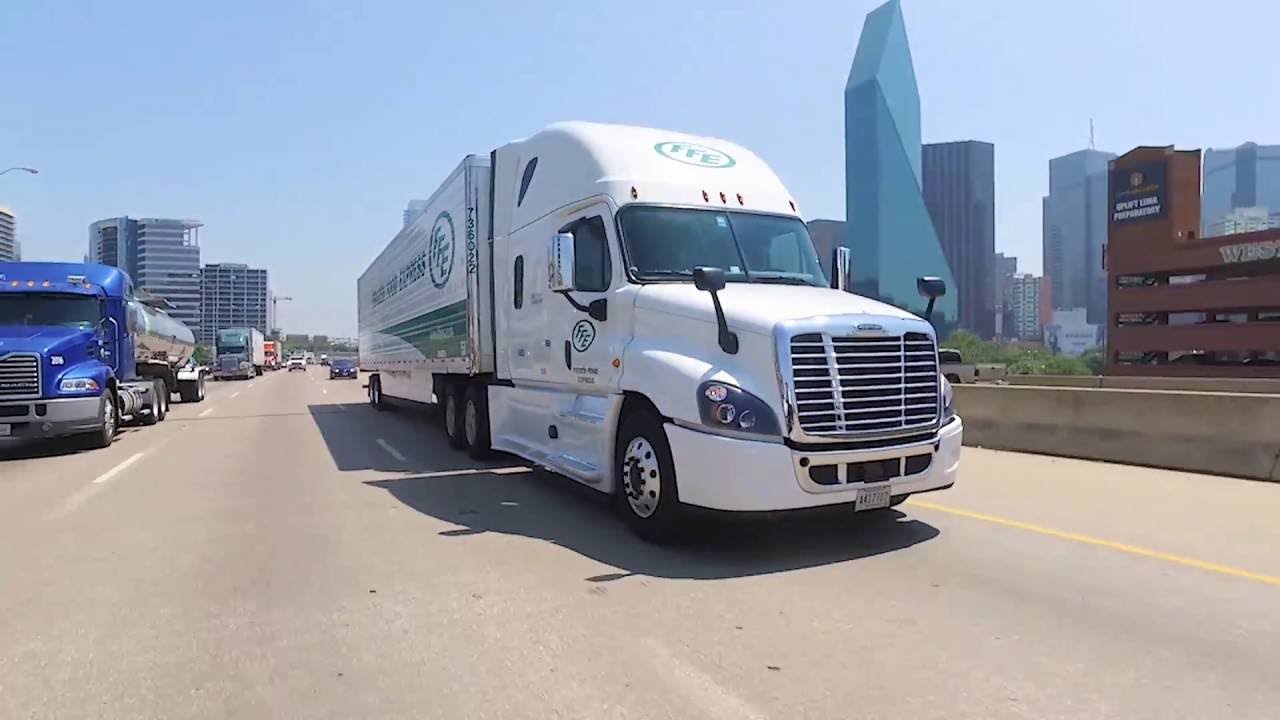
Below is a short 10 minute video preview of the company paid CDL training program offered by frozen Food Express.
The Balance of Classroom, Range, Road, and OTR Training
It helps to see the whole program as four blocks of time that build on each other. The 22-day academy in Lancaster splits into classroom theory, closed-range practice, and live-road driving, and once you pass your CDL test the program hands you off to a four-day orientation and six weeks of paid over-the-road (OTR) training with a trainer. Roughly a fifth of your total time goes to learning the rules, a chunk in the middle goes to building muscle memory on the range and the road, and the largest block by far is the OTR phase where you actually run freight under supervision.
The front of the program is theory-heavy on purpose. Your first stretch is close to 40 classroom hours aimed at the written exams and your commercial learner’s permit, because Texas won’t let you touch a truck on a public road until that permit is in your pocket. From there the balance tips hard toward hands-on work: weeks two and three are mostly range and road, with the classroom shrinking to short briefings before you go drive.
Then comes the part that dwarfs everything else. Twenty-two days gets you licensed; the six weeks of OTR training is where you become employable. You’ll log real interstate miles with a certified trainer in the passenger seat, and by the end you’ll have spent far more hours moving freight than you did in the classroom and on the range combined. That’s the right ratio for this job, because nothing on a whiteboard prepares you for a loaded reefer on a mountain grade at night.
Inside the Classroom: What You’ll Study
Your first week is mostly indoors, and it’s more interesting than it sounds. You’ll cover how a tractor-trailer’s major systems work, from the air brakes to the drivetrain, so you understand what the truck is doing instead of just reacting to it. You’ll learn the federal rules that govern commercial driving, including hours-of-service limits and the daily logs every driver keeps.
State commercial driving laws, cargo and weight rules, and the basics of trip planning round out the written material. Because FFE hauls refrigerated freight, you’ll also get grounding in cold-chain handling and the food-safety compliance that comes with temperature-controlled loads. The goal of the week is simple: pass the CDL written exams, earn your commercial learner’s permit, and walk onto the range knowing why you’re doing what you’re doing.
CDL General Knowledge and the Written Exams
The classroom week is built around one immediate goal: passing the written tests for your commercial learner’s permit. You’ll work through the general-knowledge material every CDL-A driver has to know, including how a tractor-trailer’s air-brake system works, how to run a proper pre-trip inspection, and how combination vehicles behave differently from a car. Instructors drill the same concepts the state examiner will ask about, so by the end of the week the permit-test questions feel familiar rather than foreign.
Federal Regulations, Logs, and Hours of Service
A big share of professional driving is following federal rules, and you’ll learn them before you ever leave the yard. That means the Federal Motor Carrier Safety Administration’s hours-of-service limits, how the electronic logging device tracks your driving and rest, and what a clean daily log actually looks like. You’ll also cover weight and axle limits, cargo securement basics, and the paperwork that keeps you legal at a scale house or a DOT inspection. This is the material that keeps your CDL clean once you’re earning with it.
Reefer Freight, Cold-Chain Handling, and Trip Planning
Because FFE hauls temperature-controlled food, the classroom spends time on the specialty that sets refrigerated carriers apart. You’ll learn how a reefer unit holds a set temperature, why continuous monitoring matters for food-safety compliance, and how a load can be rejected if the cold chain breaks. Add in the basics of trip planning, fuel and route management, and map reading, and you walk onto the range understanding not just how to drive the truck but why the freight in the box behind you needs the care it does.
On the Range: Backing, Shifting, and Control
The driving range is a closed lot where you learn to move a 70-foot vehicle without traffic in the picture. This is where clutch and gear work stops being theory. You’ll practice shifting a manual transmission, feeling for the right RPM, and keeping the whole rig smooth instead of lurching.
Backing is the skill that humbles almost every new driver, so you’ll spend real time on it: straight-line backing, offset maneuvers, and the dreaded parallel and dock approaches. FFE’s academy keeps the student-to-truck ratio at four to one or better, so you’re not standing around all day waiting for a turn. There’s also a state-of-the-art simulator and a refrigeration lab on site, which let you rehearse tricky situations and reefer procedures before you ever face them for real.
Shifting a Manual and Smooth Vehicle Control
FFE runs 10-speed manual Freightliners, so the range is where you learn to drive a stick the size of a house. You’ll practice working through the gears, matching engine RPM to road speed, and getting the whole 70-plus-foot rig rolling and stopping without lurching. It feels clumsy for the first day or two and then something clicks. By the time you leave the range, upshifting and downshifting on a grade is something your hands do without you thinking about it.
Backing, Docking, and Parallel Parking
Backing a trailer is the skill that separates new drivers from confident ones, and the closed range is the only place to fail at it safely. You’ll run straight-line backing, offset maneuvers, the 90-degree dock approach you’ll use every day at a warehouse, and the parallel park the state examiner scores on the CDL test. With a four-to-one student-to-truck ratio, you get real seat time instead of watching from the fence, and you’ll repeat each maneuver until it’s clean rather than lucky.
Pre-Trip Inspection and the Simulator
The range is also where the pre-trip inspection stops being a memorized list and becomes a routine you can perform under an examiner’s eye. You’ll learn to walk the truck, name the components, and catch the defects that would put you out of service. FFE’s academy backs this up with a driving simulator that lets you rehearse bad weather, tight situations, and reefer procedures without any risk, so the first time you meet a challenge for real, it isn’t actually the first time.
Behind the Wheel on Live Roads
Once your permit and your range work are solid, training moves to public roads. You’ll drive rural two-lanes, city streets with tight turns and traffic lights, and highways where you learn to manage speed, following distance, and lane changes in a loaded truck. This is where you develop the judgment a test can’t teach in a parking lot.
Everything here points toward the CDL road test. By the time you take it, you’ll have shifted through real traffic, handled busy intersections, and practiced the smooth, deliberate habits that keep a professional driver out of trouble. Pass the road test and you’ve earned your Class A CDL, and the paid, on-the-job phase of the program begins.
City Streets, Turns, and Traffic
Once your permit and range work are solid, you take the truck onto public roads with an instructor beside you. City driving comes first and it’s the hardest to fake: tight right turns that need the whole intersection, traffic lights that force you to judge stopping distance in a loaded truck, pedestrians, and lane changes where you can’t see what a car sees. You learn to think three moves ahead, because a 40-ton vehicle doesn’t get to change its mind late.
Highway Driving, Speed, and Space Management
On rural highways and interstates you build the habits that keep a professional out of trouble: managing following distance, setting your speed for the grade and the weather, merging and changing lanes with a trailer that blocks half your mirrors, and reading traffic far enough ahead to react early. FFE’s trucks are governed at 62 mph, so a lot of highway skill is about patience and positioning rather than speed. This is where the deliberate, unhurried style that defines safe truckers starts to feel natural.
Passing the CDL Road Test
Everything on the road points at one exam. The CDL road test combines a scored pre-trip inspection, a set of basic control maneuvers, and a supervised drive where the examiner watches your intersections, lane changes, and overall control. By test day you’ll have done all of it many times over with a trainer correcting the small stuff, so the test confirms what you already do rather than throwing you into the unknown. Pass it and you’ve earned your Class A CDL, and the paid on-the-job phase begins.
The Equipment You’ll Train On and Its Condition
You won’t learn on worn-out junk. FFE trains students on the same class of late-model tractor-trailers the company runs in service, which matters more than it sounds: the truck you practice backing and shifting in handles like the one you’ll be assigned after you upgrade. The academy fleet is built around 10-speed manual Freightliner tractors governed at 62 mph, so the skills transfer directly to your working truck instead of forcing you to relearn a different setup on day one.
Beyond the trucks themselves, the Lancaster campus is set up as a real training facility rather than an afterthought. There’s a driving simulator for rehearsing weather and emergency situations, a refrigeration lab for learning reefer units and cold-chain procedures, and a closed range large enough to run full backing and docking maneuvers. Because FFE keeps its equipment on a tight replacement cycle in the field, the trailers and reefer units you handle in training reflect current gear rather than something a decade out of date.
Orientation
Orientation is 4 days long. During this time you will be briefed on company policies and will be expected to fill out paperwork.
OTR Training
After orientation, you’ll begin 6 weeks of over-the-road (OTR) training with a certified driving instructor, one-on-one. During this time, you’ll run as a solo operation, with the trainer observing and guiding you from the jump seat. Once the trainer feels that you are well-equipped to handle the truck, the truck will then be dispatched as a team truck. During the entire 6 weeks of training you will be paid up to $515.06 per week, with the option to take a $75 pay advance against your future paychecks. If you wish, you can request a non-smoking trainer.
Once you have completed 6 weeks of OTR training, you will then be required to undergo a series of tests, including a CDL Road Test, Basic Knowledge Test, DOT medical exam, and a DOT drug test. Once you pass the CDL Road Test and obtain your commercial driver’s license, you will then be allowed to head back home for 5 to 6 days of rest. Frozen Food Express will provide for your transportation back home.
Once you return back to FFE, you will be assigned your own truck and will begin driving solo. You’ll start out at 29 cents per mile for the first 6 months. After 6 months you’ll begin making 30cpm. You’ll then receive a 1 cent per mile increase every year for the next 5 years. After 5 years, you’ll receive a half-cent increase every year up to a maximum of 44 cents per mile. After 90 days of full-time employment, you’ll receive full benefits.
Overall, the company paid CDL training program offered by Frozen Food Express is one of the best programs out there. While the CDL school is shorter than most other programs at only 22 days, the OTR training is longer than most at 6 weeks. There are no up-front tuition and lodging costs and no payroll deductions as long as you work for FFE for at least 1 year. Students are immediately given the opportunity to drive for Frozen Food Express upon graduating from the paid CDL training program. Benefits include consistent mileage, weekly pay, paid vacation, yearly raises, late-model equipment, and the chance to join the Drive to Own program.
What You Can Realistically Earn in Year One
Pay in trucking is usually built on the miles you drive, and FFE is no exception. As a brand-new solo driver you start at a per-mile rate that steps up after your first six months, and most first-year over-the-road drivers land somewhere in the mid-$40,000s once the miles are consistent. FFE’s own recruiting materials point to $45,000 or more in that first year.
A few things move that number. Consistent miles are the big one, and FFE leans on recession-proof refrigerated freight that stays in demand year-round, which helps keep the wheels turning. On top of base mileage pay, you can add stop pay, detention pay, layover pay, and a quarterly performance bonus for drivers who hit their mileage with a clean safety record. Because pay changes over time, treat these as a starting picture and confirm current rates with a recruiter before you sign on.
It’s also worth remembering that year one comes with a lower start rate on purpose. You’re paid throughout orientation and over-the-road training, then step onto your own truck earning while you gain experience. Very few trades pay you a real wage from week one and hand you a licensed profession at the end of it. That combination is what makes the modest first-year figure add up to more than it looks like on paper.
Pay After Five Years and the Road Beyond
Stick with it and the math improves. FFE’s structure raises your cents-per-mile every year, and by year five a solo driver has climbed well up the scale, with the top of the range reaching the mid-40s in cents per mile. At a steady 2,400 to 2,500 miles a week, that puts an experienced solo driver in the upper $50,000s or better before bonuses, and the fuel and performance incentives stack on top of that.
Drivers who want to earn more than solo work allows have room to grow inside the company. Team drivers, running with a partner, can earn up to 47 cents per mile and cover as many as 5,500 miles a week, which pushes team revenue far past what one driver can do alone. There’s also the Drive to Own path and a lease-purchase program for drivers who eventually want a truck of their own, with owner-operator mileage pay running from roughly 93 cents to $1.40 per mile. Five years in, FFE isn’t a dead-end first job. It’s a place where you have real options.
The Truck Driving Jobs at FFE and What Each One Pays
FFE isn’t a single job with a single paycheck. Once you’re licensed and off training, you can run several different kinds of freight, and the one you pick shapes both your money and your home time. Pay in trucking moves with fuel, freight demand, and your terminal, so treat the figures below as realistic ranges rather than promises, and confirm current numbers with a recruiter before you commit. All of these share the same core hiring bar: a Class A CDL, at least 21 years of age, a clean-enough driving and criminal record, verifiable work history, and passing a DOT physical, drug screen, and hair-follicle test.
Over-the-Road (OTR) Solo Company Driver
This is the default path for academy graduates and the one the training is built around. You run the lower 48 hauling temperature-controlled freight, live in the truck for weeks at a stretch, and take roughly a day of home time for every week out. OTR drivers average around 2,750 miles a week, and the freight is mostly drop-and-hook, so you spend more time driving and less time waiting on a dock.
New solo drivers typically start around $850 to $950 a week, which works out to roughly $44,000 to $49,000 in a first year once the miles get consistent, in line with FFE’s “$45,000 or more” recruiting figure. An experienced solo runner earning a higher cents-per-mile rate with steady miles can push into the $1,100-to-$1,300-a-week range, or about $57,000 to $68,000 a year, before stop pay, layover pay, and the quarterly safe-driving bonus. Full medical, dental, and vision, plus 401(k) and paid vacation, kick in after about 90 days.
Regional Driver
Regional work trades some miles for more time at home. You stay inside a section of the country, run shorter lanes, and get home more often than an OTR driver, which is why a lot of drivers move to it once family logistics matter. Regional drivers average around 2,400 miles a week, paid at roughly 39 to 44 cents a mile depending on the terminal.
That mileage and rate put a regional driver in the neighborhood of $900 to $1,050 a week, or about $47,000 to $55,000 a year. The pay is a touch steadier than long-haul because the lanes are more predictable, and you carry the same benefit package: weekly pay, medical and dental, 401(k), paid vacation, and the rider program with approval. You’ll want your CDL-A and a clean record, and some regional slots favor a little OTR seasoning first.
Local Driver
Local driving is the option that gets you home every night. You work out of a terminal, run pickups and deliveries within a metro area, and do more hands-on customer contact and dock work than a long-haul driver. It’s hourly rather than per-mile, which suits people who’d rather have a predictable schedule than chase miles.
Local pay at FFE runs roughly $21.85 to $25 an hour depending on the city, with higher rates in markets like Stockton, Portland, and Burlington, New Jersey. A standard week lands around $1,000 to $1,300 once overtime is in the mix, which comes to roughly $48,000 to $60,000 a year. Benefits match the rest of the company, and because you’re home daily, this is the lane most drivers with families gravitate toward. Requirements are the standard CDL-A, 21-plus, clean record, and DOT screening.
LTL Line-Haul Driver
Line-haul, or less-than-truckload (LTL), driving runs freight terminal to terminal on set schedules, often overnight. It’s heavy on drop-and-hook and light on customer interaction, and it usually comes with weekly home time. FFE runs regional LTL lanes concentrated in markets like New Jersey, Florida, Georgia, and Illinois.
LTL drivers can earn up to about $1,100 a week, which is roughly $52,000 to $57,000 a year, and experienced drivers coming in from outside can qualify for a sign-on bonus around $5,000. The schedule tends to be more regular than over-the-road work, which is a real draw for drivers who want predictable days off. You’ll generally need a CDL-A, a clean record, and the standard DOT physical and drug screen, and because carriers often want some history for line-haul, this can be a seat you grow into.
Team Driver
Teaming pairs two drivers in one truck so the wheels almost never stop. While one sleeps the other drives, which lets a team run up to about 5,500 miles a week and cover long, time-sensitive lanes solo drivers can’t touch. It’s the highest-mileage way to earn as a company driver, and FFE pays a team sign-on bonus of $6,000, split $3,000 to each driver.
Because the truck runs so many miles, each team driver can realistically clear around $1,200 to $1,500 a week, or roughly $62,000 to $78,000 a year apiece, depending on the rate and how hard the team runs. You share the same benefits as any company driver, plus the rider and pet programs that make living on the road easier with a partner. The catch is obvious: you have to be able to sleep in a moving truck and get along with the person you’re locked in a cab with. Requirements are the same CDL-A and clean-record standards as every other seat.
Owner-Operator and the Drive-to-Own Program
For drivers who want to run their own business, FFE’s Drive-to-Own lease-purchase program is a path to owning your truck, and experienced drivers can also lease on as independent contractors. This is the one seat where “pay” is really gross revenue, not salary. Contractors are paid by the mile, roughly 95 cents to $1.40 per loaded mile depending on length of haul, on top of a fuel surcharge, 100 percent reefer fuel reimbursement, and a lease incentive around $2,500 to start.
At real-world miles, gross revenue often runs somewhere between $2,500 and $4,000-plus a week, or well into six figures a year, but that’s before the truck payment, fuel, insurance, and maintenance come out of your pocket. What you actually keep depends on how you run the business, and plenty of owner-operators net somewhere in the $60,000 to $100,000 range while others do better or worse. FFE supports the business side with bookkeeping help, discounted insurance, and 24/7 road service. You’ll need to be at least 22, hold a CDL-A, and meet the same driving and background standards, with more weight on your track record.
The Tractors and Trailers You’ll Drive on the Job
Once you upgrade to your own truck, you’re driving late-model equipment, not hand-me-downs. FFE keeps its tractors on a tight replacement cycle, typically no older than about two years, so your assigned truck is a current-generation 10-speed manual Freightliner governed at 62 mph. The trucks come equipped for life on the road, with electronic logging devices, optimized-idle systems so you’re not burning fuel or freezing overnight, and bunk heaters for cold-weather rest.
Behind the tractor you’ll pull temperature-controlled reefer trailers, many of them dual-temp units that can run a freezer and a cooler compartment at the same time. Because the freight is high-value perishable food, the reefer units and monitoring gear are maintained closely, and the trailers are kept in service-ready condition rather than run into the ground. The freight itself is around 70 to 75 percent drop-and-hook, which means you’re often swapping a loaded trailer for an empty one rather than sitting through a live load, and that keeps your day moving.
Why Hauling Refrigerated Freight Works in Your Favor
FFE’s freight is temperature-controlled, which sounds like a technical detail but matters for your paycheck. People buy groceries, produce, and frozen goods in good economies and bad ones, so refrigerated freight stays in demand when other kinds of hauling slow down. For a new driver, that translates into steadier miles and fewer weeks sitting idle waiting for a load.
The work asks a little more of you, since reefer loads come with temperature monitoring and stricter handling, but that’s exactly what the academy’s refrigeration lab and cold-chain training prepare you for. You learn the specialty during training, then get paid for it the rest of your career.
A Guaranteed Seat When You Graduate
The reason people choose a company-sponsored school over a private one usually comes down to this: you’re not job-hunting when you finish. Because the academy is part of FFE itself, graduating and meeting the hiring requirements means you have a driving position waiting. You train knowing exactly where you’re headed.
That security cuts both ways, and it’s fair to say so plainly. FFE is training you for its own fleet, so the program is built around how FFE runs freight. In exchange for tuition-free training and a guaranteed start, you commit to driving for the company through your first year. For someone who wants a clear runway from classroom to paycheck without a financing gap in the middle, that’s a reasonable trade.
The OTR Life: Trade-offs Worth Knowing
Over-the-road driving is a lifestyle before it’s a paycheck, and going in clear-eyed is the best thing you can do for yourself. You’ll spend nights in the truck, eat on the road, and live by irregular hours and a dispatcher’s schedule. Weather, traffic, and delays will test your patience. If you have a family, home time takes planning, and the people close to you need to be on board.
The rewards are just as real. The cab is your office, the view changes constantly, and no one is standing over your shoulder for most of the day. Miles turn into steady weekly pay, the work can’t be automated away or offshored, and the skills you build only get more valuable with time.
FFE softens the early transition with rider and pet programs (both with safety approval), late-model trucks with electronic logs and bunk heaters, and an open-door management style. Ask yourself the honest questions before you commit. Are you flexible? Do you handle change well? Do you actually like the idea of travel being part of the job? If the answer is yes, the life tends to reward you.
Who This Program Fits Best
This kind of program isn’t for everyone, and it’s better to know that now than three weeks in. It fits people who want to earn while they learn and can’t front several thousand dollars for private school. It fits career changers who need a paycheck to start quickly rather than a certificate and a job search. And it fits anyone who’s genuinely willing to be away from home during training and the early driving months.
It’s a harder fit if you need to be home every night from day one, or if a one-year commitment feels like a trap rather than a fair exchange. There’s no shame in either answer. The drivers who thrive at FFE tend to be the ones who walked in understanding the deal and wanted it anyway.
Other Ways to Drive for FFE
Let’s face it, not everyone wants to live on the road for weeks at a stretch, and FFE has lanes for that. Local and regional positions keep you closer to home with more frequent home time, trading some mileage for a shorter leash. These roles suit drivers who’d rather sleep in their own bed most nights and don’t mind more hands-on customer contact.
Team driving is the high-mileage option, pairing two drivers so the truck keeps moving and the revenue climbs. Experienced drivers who want to run their own business can move into the lease-purchase and Drive to Own programs and become owner-operators. And if you’re leaving the military, FFE actively recruits veterans (one of its founders served as an Army Master Sergeant), offering CDL training to those without a license who live in Texas or Illinois, and driving positions to those who already have military driving experience or a Class A CDL. Whatever version of the job fits your life, the door in is the same academy.
From Application to First Load: The Short Version
The path is more straightforward than most people expect. You apply, clear the background and driving-record checks, and pass a DOT physical and drug screen. You arrive at the Lancaster academy, earn your permit in the classroom week, and build your skills on the range and the road until you pass the CDL test. Orientation and paid over-the-road training follow, and once you upgrade you’re assigned your own truck and start running solo.
From your first classroom morning to your own truck is a matter of weeks, not months. That speed is the whole point of an accelerated, company-paid model. It gets you licensed, employed, and earning without the long, expensive detour a lot of new drivers assume is unavoidable.
Benefits:
- Your training is tuition-free with no payroll deductions if you work for FFE for 1 year.
- All expenses, except meals and basic living costs are covered by Frozen Food Express.
- You’ll stay free of charge while you train, either in FFE’s on-campus dorm at the Lancaster academy (single rooms with a private bath, free laundry, and meals provided) or at a local hotel with shuttle service to and from the academy.
- Cheap meals are are available during training, and meals are paid for during 4-day orientation.
- Students learn professional driving techniques.
- Guaranteed employment upon graduation.
- Weekly pay.
- Consistent mileage with yearly pay increases.
- Full benefits after 90 days: medical, dental, and life insurance, plus 401(k) and employee stock plan.
- Paid vacation: After 1 year/1 week paid out at $680. After 2 years/2 weeks paid out at $1400.
- OTR drivers get 1 day of home time for every 1 week out. Regional drivers get 2 days for 2 weeks out.
- Drivers receive a fuel bonus based fuel savings and average MPG.
- Drivers receive a quarterly performance bonus of $300 for 8,500 paid miles/month with a safe track record.
- Drivers get layover pay of $75 for every 24 hours they are laid over.
- Stop pay, detention pay, and breakdown pay is also available.
- Late-model equipment no older than 24 months, with electronic logs, opt-idle systems, and bunk heaters.
- All trucks are 10-speed manual Freightliner trucks governed at 62 mph.
- Freight is 70% drop and hook.
- Drivers are allowed 1 dog under 50 lbs. or 1 cat. There is a $100 deposit required and 1cpm decrease in pay.
- Drivers are allowed to have one passenger, 12 years or older with company approval and proper insurance.
Requirements:
- You must be a Texas resident to apply at Frozen Food Express.
- You must be at least 21 years of age.
- You must possess a valid U.S. state driver’s license for at least 2 out of the last 3 years.
- You must bring your original and signed Social Security card.
- You must bring your birth certificate.
- You must have a good 5-year driving record with no careless driving convictions less than 3 years old.
- You must not have had any open container violations in the last 5 years.
- You must not have had more than 1 DUI/DWI in the last 10 years.
- Any DUI/DWI that occurred inside a tractor-trailer will disqualify you immediately.
- You must undergo a criminal history background check.
- You must not have had any felony convictions in the last 10 years. These will be reviewed on a case-by-case basis.
- You must not have had any violent felonies or major drug convictions in your lifetime.
- You must not have had any misdemeanor convictions in the last 3 years,
- You must not have had any illegal substance, sex, or theft misdemeanors in the last 10 years.
- You must have a verifiable 5-year work history.
- You must pass a DOT drug test.
- You must pass a DOT physical examination.
- You are contractually obligated to work for FFE for 1 year after graduation.
- You must pay $150 in CDL permit fees.
- You must pay for your meals during training.
- You cannot pay your own tuition up-front.
- If you quit working for FFE before your first year is complete you must pay $3000 tuition cost.
- You must be physically able to do the job.
- You must be mentally and physically able to be away from home for at least 7 days at a time.
Frequently Asked Questions About FFE’s Paid CDL Training
Have questions about FFE’s company-sponsored CDL training program? These commonly asked questions cover eligibility, training costs, pay, housing, home time, hiring requirements, and what you can expect from your first day at the academy through your transition to solo driving.
Do I have to be a Texas resident to attend FFE’s academy?
Yes. FFE’s Student Driver Academy in Lancaster only accepts Texas residents for company-sponsored training. If you already hold a Class A CDL or have military driving experience, FFE hires drivers from outside Texas, but the tuition-free school itself is a Texas-resident program.
How much does the training actually cost me?
Nothing up front, and nothing at all if you stay. There’s no tuition, no student loan, and no credit check. The only catch is the commitment: if you leave FFE before your first year is up, you owe a $3,000 tuition repayment. Finish the year and the training is genuinely free. You’ll still cover small personal costs like your CDL permit fees.
How long is the whole program from start to solo?
The academy portion is 22 days, covering classroom, range, and road. After you pass the CDL test, you move into a four-day paid orientation and then six weeks of paid over-the-road training with a trainer. From your first classroom morning to your own truck is a matter of weeks, not months.
Do I get paid during training?
Partly. The 22-day academy phase itself isn’t paid as a wage, though FFE covers your housing and meals during it. The six-week OTR training phase after you earn your CDL is paid, up to $515.06 a week, with the option of a $75 advance against future paychecks. Once you upgrade to your own truck, you move to full driver pay.
Where will I stay while I’m at the academy?
FFE provides housing during training, so you’re not paying for a hotel out of pocket. Meals are provided too, three a day Monday through Saturday and two on Sunday. Transportation to the academy can also be arranged; ask your recruiter for the current details, since arrangements change from time to time.
Do I need any driving experience to get in?
No. The academy exists specifically for people without a CDL-A or professional driving background. You’ll start from the written permit test and be trained through to your license. What you do need is a clean-enough record, a verifiable work history, and the ability to pass a DOT physical along with drug and hair-follicle screening.
What kind of freight will I be hauling?
Temperature-controlled food, mostly. FFE is the country’s largest asset-based temperature-controlled LTL carrier, so you’ll pull refrigerated reefer trailers carrying perishable and frozen goods. The upside for a new driver is that this freight stays in demand in good economies and bad, which tends to mean steadier miles.
How much time will I spend away from home?
It depends on the job you take. Over-the-road drivers are out for weeks and get roughly a day home for each week out. Regional drivers get home more often, line-haul usually offers weekly home time, and local drivers are home every night. Many drivers start OTR and move to regional or local as their life needs change.
What are the age and background requirements?
You must be at least 21, hold a valid driver’s license, and have a reasonably clean recent driving record. FFE runs a criminal background check and is stricter than some carriers. It requires no more than one alcohol-related conviction (and none in the last five years), a verifiable work history, and passing DOT physical, drug, and hair-follicle tests.
What happens right after I graduate?
You finish orientation and your six weeks of paid OTR training, pass your upgrade checks, and get assigned your own solo truck. From there you’re earning driver pay, and full benefits, including medical, dental, vision, and 401(k), start after about 90 days of full-time work.
FFE Trucking School Location:
FFE Driving Academy
3400 Stonewall Street
Lancaster, TX 75134
Get Paid While You Train and Make $45,000 or More Your First Year with Paid CDL Training!
Are you ready to take the next step and begin your career as a well-paid professional truck driver? We’ve partnered with some of the best trucking companies in the nation and have helped thousands of people just like you get into a high quality paid CDL training program. You can get your CDL in as little as 3 weeks and start making good money as a professional truck driver. Plus, you can make up to $500 per week while you train!

Here’s what you can expect from the paid CDL training programs in our network:
- Earn up to $500 Per Week While You Train
- Top Quality CDL Training
- Competitive Pay
- Great Benefits
- No Credit Check Required
- Qualified Graduates Have a Job Waiting For Them
Just click the green button below and fill out the quick 1-minute application on the next page to get started. Hurry! Classes are filling up fast!
More Paid CDL Training Reviews
Click on a trucking company below to read our review of their paid CDL training program.
Scroll & Select:
Student Reviews
If you are a current student, former student, or a graduate of FFE Trucking School, please leave an honest review of their paid CDL training program and rate the six different criteria underneath the review form by filling in the stars. You will be helping prospective students who may be interested in this program by providing some valuable insider information.
Instructors, employees, and owners of the truck driving school are prohibited from leaving a review and rating their own school! Students only please.
Student, please follow the instructions below to rate and review this program:
- Fill in the review form below, including your name and email address.
- Give your review a title.
- Write an honest review of the paid CDL training program.
- Use the 5-star rating system below the review form to rate the six different criteria of the school.
- Click the “SUBMIT” button to submit your rating and review.
Be the first to leave a review.